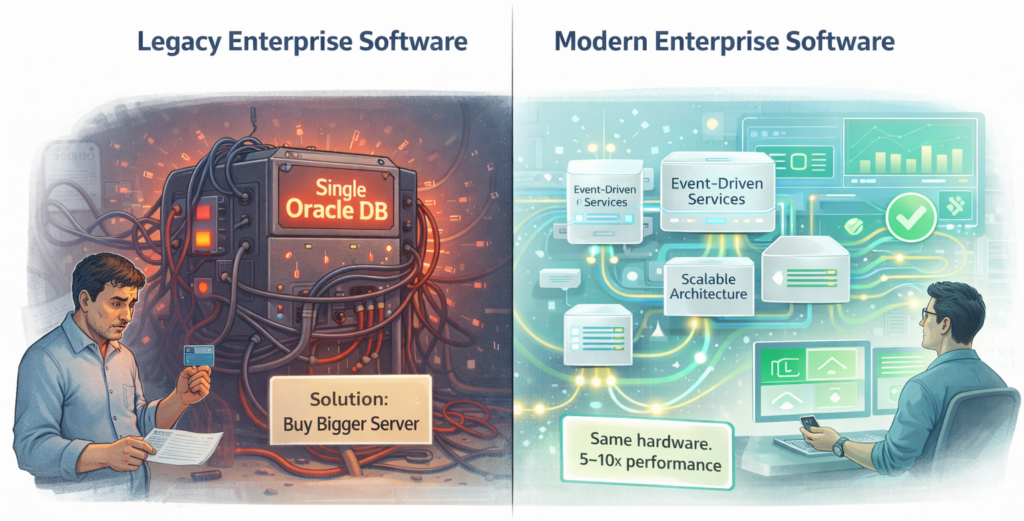
For years, the default performance strategy in enterprise IT looked something like this:
👉 “It’s slow? Buy a bigger server!”
👉 “Still slow? Buy an even bigger one!”
I’ve seen this firsthand in a large enterprise environment that relied on a single Oracle DB instance – no horizontal scaling, no real way to distribute load. When performance hit a wall, the solution wasn’t architectural change… it was simply a more powerful (and more expensive) server. Predictable outcome, predictable limits.
Modern enterprise software performs better not because CPUs magically got faster, but because the architecture finally caught up with reality:
🔹 Designed to scale, not just grow. Modern systems scale horizontally instead of putting all their hopes (and budget) into one heroic machine.
🔹 Event-driven & asynchronous by default. Less waiting, fewer bottlenecks, more parallel work getting done – no traffic jams at the database entrance.
🔹 Smarter data usage
Right data, right place, right time – rather than “everything goes through one DB and we pray”.
🔹 Built for change, not fear of it
Continuous optimization beats “don’t touch it, it’s fragile” every time.
For example, with the same hardware specifications, AppTrice products outperform legacy solutions by 5-10×. That doesn’t just mean better RPS – it means a smaller footprint, lower operational costs, and less time spent feeding and maintaining oversized infrastructure.
Turns out the best performance upgrade isn’t always a bigger server – it’s better software.
Curious to hear: what’s been your biggest performance bottleneck when working with legacy systems?